
Digital Jump Rope and Videogame
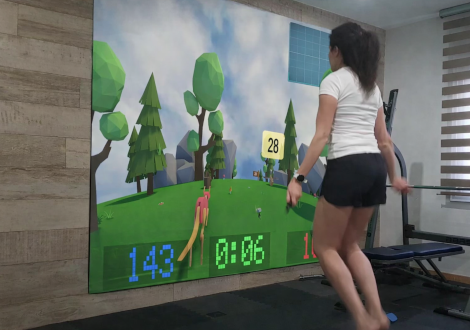
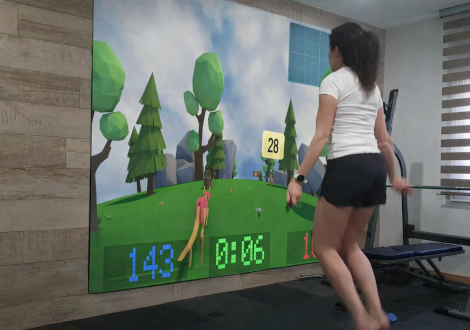
This project merges a real-world workout with an interactive video game. It features a custom-built wireless jump rope that acts as the controller for a game where you control a kangaroo. Your real-life jump speed dictates how fast the kangaroo moves through a virtual world, turning a repetitive exercise into an engaging experience. The game displays live stats and even lets you race against your own past performances, which appear as little birds on the screen.
Project
This system is composed of two main parts: the custom-designed hardware for the jump rope and the video game software that brings the experience to life.
Hardware: Digital Wireless Jump Rope
The goal was to create a responsive, wireless jump rope that could accurately track rotations without interfering with the workout.
-
Enclosure and Mechanics: The handle’s case was designed from scratch in Fusion 360 and then 3D printed. Inside the handle, the spindle axle is fitted with a small, neodymium magnet. This magnet is the key to tracking rotations.
-
Rotation Sensing: A Hall effect sensor is positioned just below the path of the spinning magnet. The sensor measures how the magnetic field changes as the magnet rotates.
-
Electronics and Connectivity: The brain of the jump rope is a Teensy 2.0 microcontroller, based on the ATmega32u4 chip. It reads the pulses from the Hall effect sensor, calculates the real-time jumping speed, and transmits this data wirelessly. To ensure the connection was as fast as possible, an RFM12B radio module was chosen for its reputation for super low-latency communication. A second Teensy and RFM12B module are housed in a small USB dongle that plugs into the computer to act as the receiver.
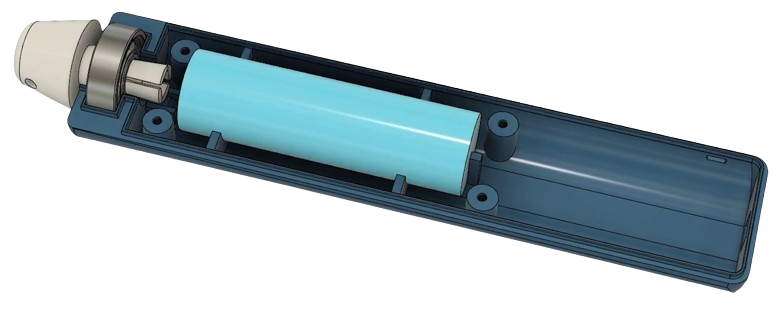
Cad design of the jump rope case
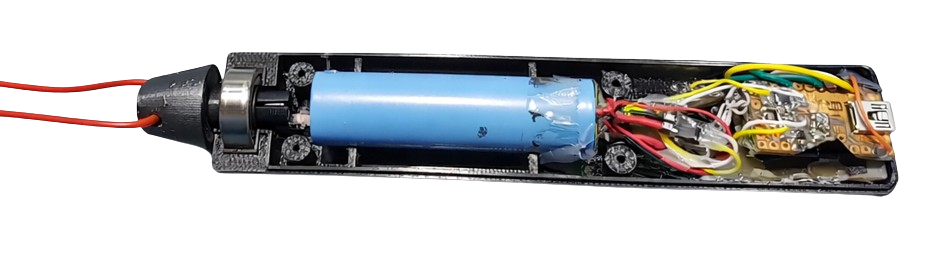
Digital wireless jump rope prototype
Software: Kangaroo Infinite Runner
The video game was developed in Unity. The primary design challenge was to create a fun feedback loop that would motivate longer and more intense workouts.
-
Core Mechanic: The game receives the jump data from the wireless rope in real-time. This data directly controls the animation of the main character, a kangaroo, making it jump in perfect sync with the user. The calculated jumps-per-minute (JPM) speed also determines how fast the kangaroo travels forward through the game’s world.
-
User Interface and Data Display: A digital interface keeps the user informed without being distracting. Key statistics are displayed on-screen, including:
-
Total Jumps
-
Workout Time
-
Live Speed (in Jumps Per Minute)
-
Heart Rate (if a compatible monitor is used)
-
-
Motivation and Replayability: To encourage improvement, the game records each workout session. When you start a new session, your previous runs are represented by small birds that fly alongside your kangaroo, matching the pace you held at that point in your prior workout. This creates an intuitive “ghost” mode, allowing you to compete against yourself. At the end of a workout, a statistics screen summarizes your performance, showing your top speeds over different time intervals.
Core Technologies Used
-
Game Development: Unity Engine
-
3D Modeling & Hardware Design: Autodesk Fusion 360
-
Hardware Prototyping: 3D Printing
-
Microcontroller: Teensy (ATmega32u4)
-
Wireless Communication: RFM12B Radio Modules
-
Sensing: Hall Effect Sensor and Neodymium Magnet